 Initial CFI "Checkride Ready!™"
CFIs are the #1 "Aviation Influencers!" What you say, do, and teach will determine the future of aviation.
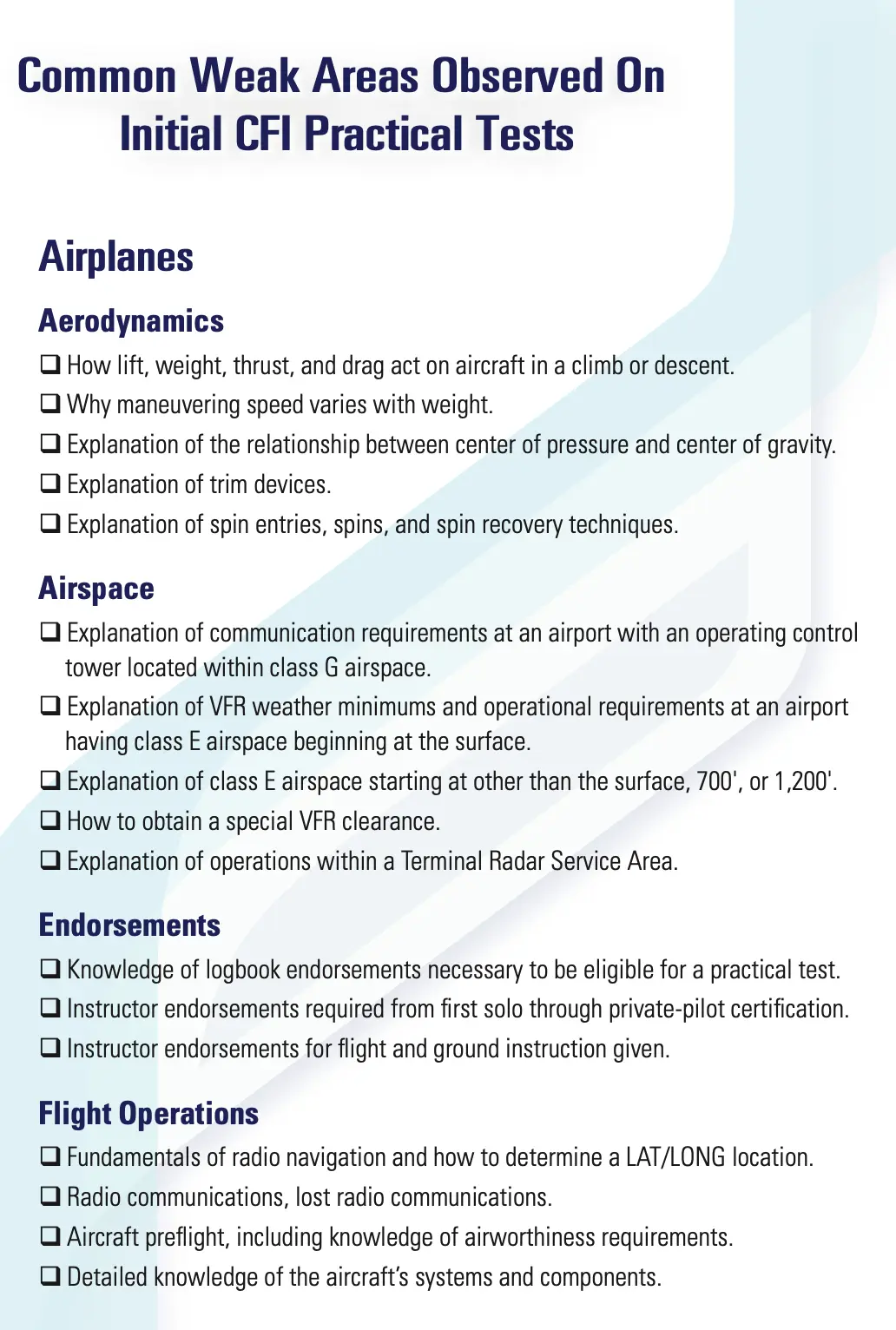
The initial CFI is a comprehensive evaluation that encompasses all that you have been taught until now. Step one requires you to examine *your* skills and knowlege and compare/sync w/FAA Handbook Guidance. Depending on your previous training, it may be required that you "relearn" some (or all) of the way you have understood and flown some maneuvers! All of your teaching and maneuver descriptions must conform to the FAA guidance in the FAA handbooks! (see the ACS references)
Preparation = CONFIDENCE/SUCCESS!
You will impress your FAA Pilot Examiner!
Initial CFI Success
Prepare and Ace Your Test!

Your objective for the flight portion of the CFI evaluation is to provide clear and accurate instructional knowledge (not "word salad"). Too many applicants "babble!"
To achieve this concise, in-flight instructional ability you must create a practiced and refined prebrief explanation (script) that you recite before flying every maneuver. (When you find yourself reciting this in your sleep, you are ready for the test)
This "boilerplate" description of each required maneuver must be clear and simple. Spend time writing and refining it for each maneuver with reference to the FAA Handbook guidance. Then memorize and recite this verbally, both in practice and on the test *before* you fly every maneuver.
This script is recited while clearing the area and preparing for the maneuver. Many applicants make the mistake of clearing first and then flying out of the cleared area while "explaining the maneuver." Speak slowly and add pauses so your learner has time to digest your content: (this essential skill is called "chunking"):
e.g. "The chandelle is a maximum performance 180° climbing turn with two separate 90° segments."
(pause & breathe)
"Start by applying full power and smoothly rolling into a 30° bank. Simultaneously increase the pitch continuously to achieve an approximate Vy nose picture at the 90° point."
(pause & breathe)
"The second 90° of the turn maintains this pitch attitude (with continuously increasing back pressure) while smoothly rolling to a wings level attitude at the 180° point. The target speed at completion is just above a stall with the warner activated."
(pause & breathe)
"Both yoke pressure and rudder pressure increase continuously throughout this entire maneuver."
"The final portion of this maneuver requires you to maintain altitude and heading while accelerating to normal cruise flight (this will require forward pitch/trim while releasing rudder pressure slowly)"
The details/forces/reasons - the "why" - must be covered in detail during the ground brief. For every maneuver, know the ACS limitations, but remember (and convey to your learner) that *all flying* is actually a continuous series of corrections. Exceeding the limitations is undesirable but not necessarily an immediate failure! (the examiner is required to clearly state if/when you failed). "Failure to promptly correct" is what the ACS defines as failure. Recommended YouTube: Know Your ACS!
Detailed discussions are way to complicated to explain in flight. (we teach on the ground and demonstrate/practice in flight)
Demonstrate to the DPE you are aware of any deviations and fixing them promptly (remember "perfection is not the standard"). If you are "consistently exceeding standards" you will probably be disapproved ("more training!")
Exceeding any aircraft limitation (flap speed is common) is an immediate failure so give yourself a margin on these. Know all your performance speeds and the bold faced checklist items (immediate action items) *must* be memorized."Essential Aerodynamics"

Comm As "Participation Trophy?"
CFIs & DPEs Create Pilot Excellence!

Flight portion: Fly and Teach!
Practice with concise index card summaries
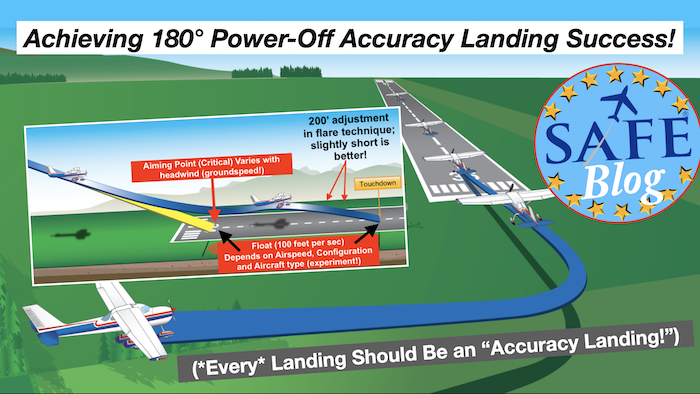
"180 Power-Off"
Mastering Accuracy Landings
Join SAFE and SAVE!"
Amazing 15% OFF ForeFlight!

Easy "Pilot Math!"
Save Immediately!
(Even if you Just Renewed!)